How Much Exercise Does a Kangal Need? Plus Brain Games
General training information. Every dog is an individual; for health or behavior concerns, see your veterinarian.
If you are asking how much exercise a Kangal needs, the honest answer is less about miles and more about meaning. This is a livestock guardian, not a jogging partner or a ball-chasing athlete.
Below is a step-by-step plan for Kangal exercise and Kangal mental stimulation that respects what the breed was built to do. I will also tell you where the breed clubs give no number, because I will not make one up.
What the Breed Was Built For
The Kangal Dog Club of America (KDCA) describes the original job as flock protector. The dog confronts and intimidates predators such as wolves, cougars, bears and feral dogs. It does not herd.
That history shapes the energy profile. The KDCA says the breed is calm and economical with effort and conserves its energy. It also says a Kangal needs a job, or people and activities, to prevent boredom.
So the goal is not to tire the dog out. The goal is to give a thoughtful, watchful dog useful things to do.
So, How Much Exercise Does a Kangal Need?
The KDCA says Kangals need daily walks for physical and mental stimulation. It does not give a set number of minutes or miles, and neither does the United Kennel Club (UKC) in the information I relied on.
Anyone quoting you an exact figure is guessing. Ask your veterinarian and the breeder or rescue you work with what suits your individual dog's age, build and health. Individual dogs vary.
What the sources do support is this: a daily outing, plus daily mental work, plus a safe place to move around and watch the world.
Materials You Will Need
- A well-fitted flat collar or back-clip harness and a sturdy leash (no prong, choke or shock tools)
- Secure fencing, checked often (more on this below)
- Small, soft treats your dog loves
- A puzzle feeder or a snuffle mat, or a muffin tin and tennis balls for a homemade version
- A few cardboard boxes and some scrap paper for foraging games
- A long, secure line for sniff time in safe areas
- A water bowl and a shady spot to rest
Step-by-Step: Building a Kangal Exercise Routine
Step 1: Secure the yard before anything else
The KDCA lists good fencing as a requirement. It notes that some Kangals have climbed 6-foot fences, that they dig dens, tunnels under fences and craters, and that puppies may look for openings and wander.
Walk your fence line every week. Look for gaps, loose boards and fresh digging at the base. A yard is not a substitute for a walk, but it is where your dog will spend much of the day, so it has to be safe.
Step 2: Start with a daily leashed walk
Plan a walk every day. Keep it steady and unhurried, which suits a dog the KDCA describes as economical with effort.
The KDCA also says a Kangal cannot be trusted off-leash unless somewhere extremely remote and after extensive training. Treat the leash as standard equipment, not a punishment.
Reward your dog with a treat whenever the leash is loose. Keep your voice calm and your cues clear.
Step 3: Turn part of the walk into a sniff walk
A sniff walk is simple. Pick a route, then let your dog choose the pace and the stops. Pause when your dog wants to investigate a scent, and move on with a cheerful cue.
This fits a dog bred to monitor its surroundings. Scent work is a calm way to use the brain without adding speed or impact. Choose quiet places, since the UKC describes the breed as reserved with strangers unless the owner is present, and the KDCA says Kangals are wary of strange dogs.
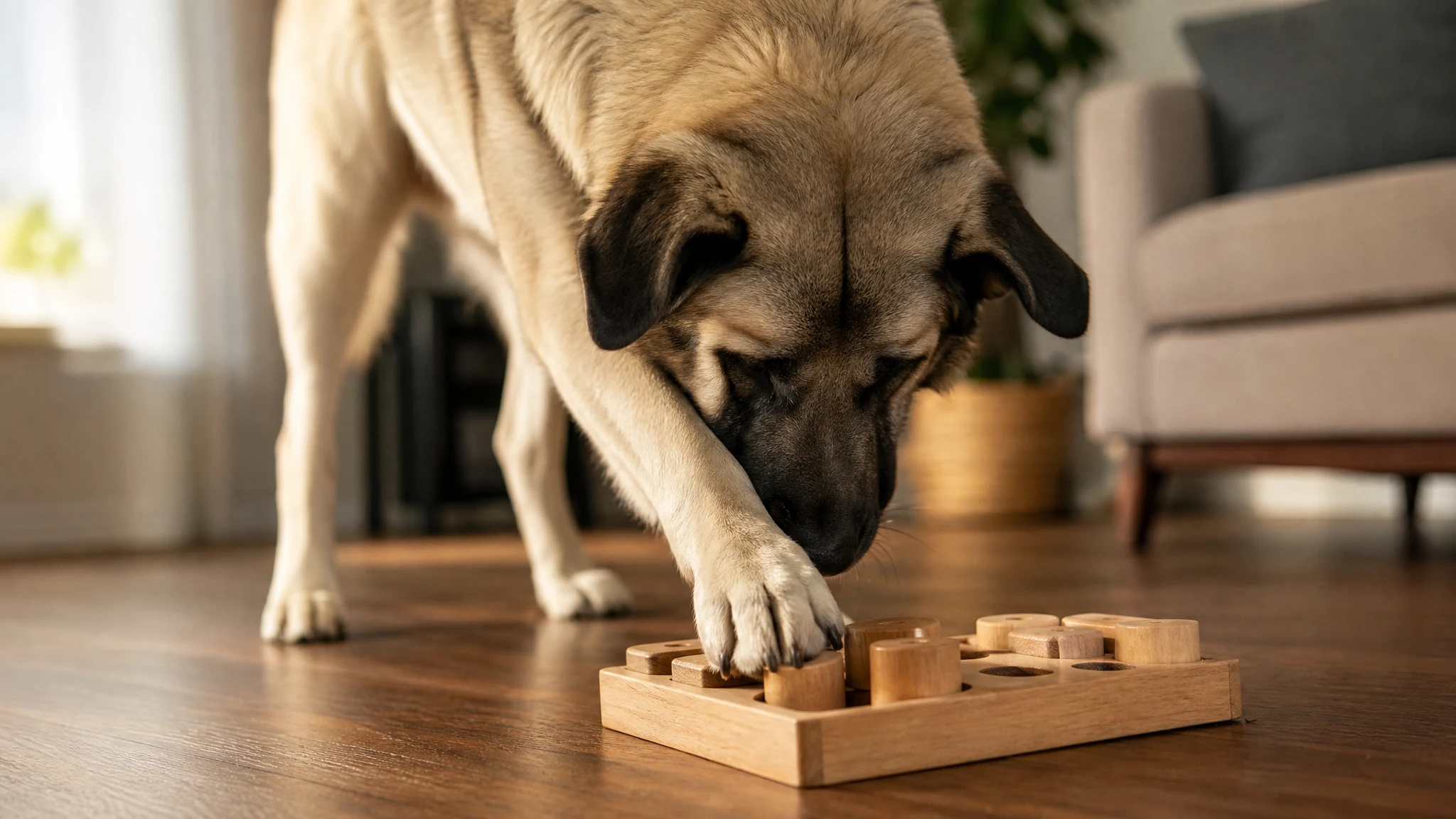
Step 4: Add a daily puzzle meal
Swap the bowl for a puzzle feeder, a snuffle mat or a scatter of kibble in the grass for some meals. Start easy so your dog wins quickly, then raise the difficulty a little at a time.
Your veterinarian is the right person to ask about portions and meal timing. Bloat appears on the Vet Desk's list of serious health issues for the breed, so ask your vet what feeding and activity routine makes sense for your dog.
Step 5: Play short training games
The KDCA calls the breed intelligent and quick to learn but independent. It says a Kangal may ignore commands when something more interesting is nearby.
That is a reason to keep sessions short, rewarding and varied. Try a few minutes at a time of:
- Look at me: reward each time your dog glances at your face.
- Settle on a mat: reward your dog for lying on a mat, then slowly add time.
- Touch: teach your dog to bump your hand with the nose, then use it to move past distractions.
- Come when called, indoors first: practice in a quiet room with high-value treats before trying anywhere more distracting.
End each session while your dog is still interested. For the bigger picture on manners and socialization, see the complete guide to Kangal training for owners.
Step 6: Give your dog a watch job
Because the breed was developed to guard, many Kangals settle best when they can observe. A shaded, safe spot with a view of the yard can serve as a lookout post.
Keep it calm. The KDCA says the breed barks and roars, especially at night when it senses coyotes or other threats. Think about your neighbors and your dog's sightlines, and do not reward barking at passersby.
Step 7: Rotate foraging and search games
Hide a few treats in cardboard boxes or under crumpled paper and let your dog work it out. Another option is to scatter treats along a short trail in the yard and cue your dog to find them.
Change the game every few days. Novelty is what keeps a smart, independent dog engaged.
Step 8: Plan rest as part of the routine
Rest is not laziness for this breed. Because the KDCA describes it as conserving energy, a quiet afternoon is normal. Keep fresh water and shade available, and do not push a dog that is slowing down.
Exercise by Life Stage
| Life stage | What the sources say | What to do |
|---|---|---|
| Puppy | The KDCA says puppies grow rapidly into very large dogs, and a 6 to 12 month old puppy can weigh 80 to 130 pounds. The Vet Desk says the breed matures more slowly than smaller breeds. | Keep outings gentle and short, and favor sniffing, easy training games and socialization. The sources I used give no joint-safe limits, so ask your veterinarian how much activity is right at each age. |
| Adolescent | The KDCA says problem behaviors emerge in adolescence without training and socialization, and are harder to retrain. | Keep up daily training, supervised socializing and mental work. Do not let the routine lapse. |
| Adult | The KDCA calls for daily walks and a job or activities to prevent boredom. | Combine a leashed walk, a sniff walk, a puzzle meal and short training sessions. |
| Senior | No club guidance was found. The Vet Desk gives a life expectancy of 11 to 13 years. | Ask your veterinarian how to adjust activity as your dog ages. |
A note on joints
The Vet Desk lists hip dysplasia and elbow dysplasia as serious health concerns in the breed. I cannot tell you how to screen for or manage them. Talk to your veterinarian about your puppy's growth, and ask the breeder what health information they can share.
Tips for Success
- Socialize early and keep going. The KDCA says socialization for a companion Kangal must start very young and continue into adulthood.
- Stay gentle but firm. The KDCA says excessively harsh obedience methods are detrimental. Reward-based training, in line with the American Veterinary Society of Animal Behavior (AVSAB), is the way to go.
- Introduce new animals properly. The KDCA says new animals must be introduced with care, and that a Kangal may threaten or even kill animals it believes are predators.
- Keep sessions short. A few focused minutes beat a long, boring drill.
- Vary the routine. Change the route, the game and the reward.
Common Mistakes to Avoid
- Trying to wear the dog out. This is not a high-drive sport breed, according to the KDCA's description. More distance does not fix boredom.
- Trusting the recall off-leash. The KDCA warns against it unless the setting is extremely remote and training is extensive.
- Relying on the fence alone. Check it regularly, since some Kangals climb, dig and tunnel.
- Skipping socialization. Waiting until adolescence makes the job harder.
- Using force. Shock, prong and choke collars, alpha rolls and scruffing have no place here.
- Treating it as a protection-dog hobby. The KDCA says the breed is not a personal protection dog and is not seen in Schutzhund work. It adds that the Turkish military tested the breed and concluded it was unsuitable.
Expected Results
With a steady routine, many owners find their Kangal is calmer and easier to live with. Daily mental work may help reduce boredom-driven behavior such as digging or fence testing, though results vary from dog to dog.
Training and socialization may also make your dog easier to handle on walks and around visitors. Give it weeks and months, not days. If your dog's behavior worries you, or you notice limping, stiffness or other changes, talk to your veterinarian and a qualified reward-based trainer.
A note on suitability: the KDCA says the breed is not for first-time owners. If you are still deciding whether a Kangal fits your life, read the club's guidance before committing.
Quick Daily Checklist
- Check the fence line and gate.
- Take a leashed walk with a sniff break.
- Serve at least one puzzle or foraging meal.
- Practice a few minutes of reward-based training.
- Offer a shaded lookout spot and plenty of rest.